
19 Jul Are smart contracts taking over the world? What are the advantages and disadvantages?
Many people are of the view that, like artificial intelligence, smart contracts are going to take over our lives and relegate “traditional” or “paper” contracts to history. How likely is this to happen? In our view, smart contracts have a role to pay but there will always be a need for “paper” agreements. The “smartness” of a smart contract is determined by the methodology used to regulate transactions and the quality of its coding. They are well suited for environments that entail high volumes of transactions in finance, digital goods or digital workflow procedures like supply chains. They are not applicable in many areas that rely on performances that cannot be digitally regulated.
According to Wikipedia “smart contracts” were first proposed in the early 1990s by Nick Szabo, computer scientist, cryptographer, and lawyer. He coined the term, using it to refer to “a set of promises, specified in digital form, including protocols within which the parties perform on these promises”. The concept has arisen with blockchain technology before crypto currencies or assets became common place.
Attraction.
Smart contracts consist of two equally important parts. Firstly, the computer code set, and secondly, the relevant data. The code manages the functionality of the contract while the data manages the conditions and performance. These smart contract components are located at a specific address in a blockchain. They therefore provide functionality that goes beyond traditional or “paper ” contracts.
The attractiveness of these contracts is that they facilitate the automatic exchange of value. They do not require banks, governments, or intermediaries to guarantee contract adherence.
Functionality.
The functionality of a smart contract at a very basic level can be as follows:
Step 1:
Terms are agreed between parties regarding the execution of defined actions upon the occurrence of defined trigger events. These are hard coded into a digital contract located in a blockchain (public or private).
Step 2:
The first in a series of trigger events occurs, such as the receipt of an order for goods. The code initiates the programmed action, being the automatic shipment of the goods for example. The act of shipment triggers another event which is the payment for the goods.
These contracts therefore function in the same way as a “paper” agreement, yet the performance is rendered digitally. They operate like the “IF ” functionality in Excel, namely “if – then”. The requirement is that the “if ” and the “then” information must be digitally available without human intervention.
The concept behind these contracts is not new. There are many software solutions that facilitate similar functionality, particularly in financial transactions. See for example the payment guarantee solution offered by G-Pay (https://www.gpay.co.za/). The difference is the fact that smart contracts are based a distributed ledger blockchain technology such as Ethereum, Cardano, and Hyperledger Fabric. This means that there is a non-centralised, immutable record of the contract and its execution that is in the public domain. It does not reside in a database controlled by one of the parties or a service provider.
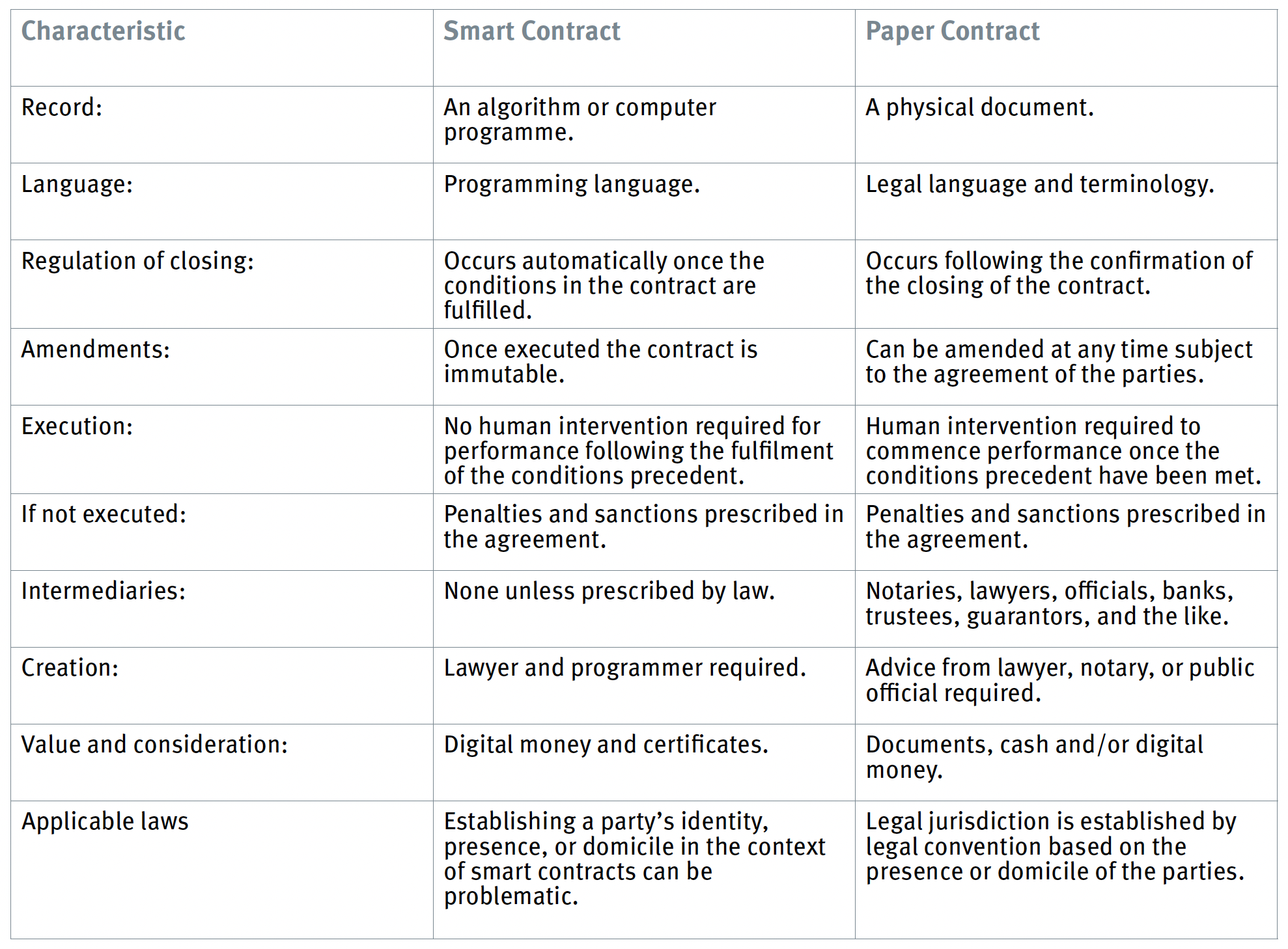
The main similarities and differences between smart contracts and paper contracts are:
Advantages of smart contracts:
- Transparency: As these contracts are hosted on the decentralised blockchain, there is complete transparency. All transactions are therefore within the public domain and are easy verifiable.
- The Terms of Operation are Immutable: The terms of the contract cannot be changed meaning that no-one can interfere with the operation of the contract resulting in non-performance or theft.
- Economic Efficiency: They can make businesses with high levels of transaction processing and monitoring more efficient and eliminate loss due to human error, fraud or theft. They do not require intermediaries such as lawyers, bankers and intermediaries. The code is writ ten once, which is then used whenever needed.
- Greater level of trust: The contract is implemented automatically and does not require the input of anyone for it to be executed. This eliminates human error and the opportunity for non-performance.
- Secure storage and backup: The risks associated with the security and maintenance of transaction data. As the contracts and performance is recorded on the distributed blockchain servers and there is no risk of it being lost.
- Fraud prevention: Properly coded smart contracts allow no chance for unauthorized access to the system that prevents fraud.
Disadvantages of smart contracts:
- Security: The technology is relatively new which means that gaps may be found and exploited.
- Risks for complex transactions: Gartner is of the view that smart contracts with multiple parties may create problems with their manageability and scalability.
- Immutability: The fact that once the contracts have been created, they cannot be changed can be problematic if the circumstances change and contract terms require amendment or the workflow processes change.
- Currency: Smart contracts are settled using a crypto currency and cannot be settled in fiat currency.
Smart contracts have benefits and advantages but in our view, are not appropriate in all circumstances.
William Marais
Executive Director
Mettle Corporate & Specialised Finance
wmarais@mettle.net
https://mettle.net/investments/corporate-and-specialised-finance
+27 82 807 3349